
Proven to help patients
achieve more "On" time
Superior improvement in daily good “On” time and “Off” time vs oral IR CD/LD1*†
~3x
increase in daily
good “On” time
vs oral IR CD/LD1*†
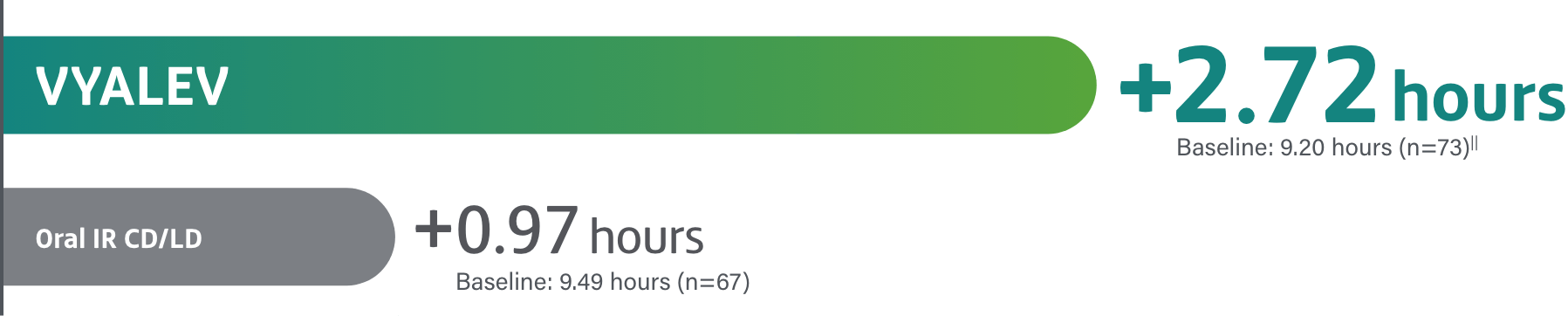
Mean difference=1.75 hours; P=0.0083
*Good “On” time (“On” time without troublesome dyskinesia) was defined as the sum of “On” time without dyskinesia and “On” time with non-troublesome dyskinesia and was assessed using a PD diary.1
†2.80x increase.1
‡The “On” and “Off” time were normalized to a daily 16-hour awake period. Daily normalized "Off" and "On" times are averaged over valid PD diary days for each visit to obtain the average daily normalized times.1
§Data based on least squares mean.1
||One of the 74 patients who received VYALEV did not have PD diary data.1
~3x
decrease in daily
“Off” time vs
oral IR CD/LD1†

Mean difference=–1.79 hours; P=0.0054
*Good “On” time (“On” time without troublesome dyskinesia) was defined as the sum of “On” time without dyskinesia and “On” time with non-troublesome dyskinesia and was assessed using a PD diary.1
†2.86x decrease.1
‡The “On” and “Off” time were normalized to a daily 16-hour awake period. Daily normalized "Off" and "On" times are averaged over valid PD diary days for each visit to obtain the average daily normalized times.1
§Data based on least squares mean.1
||One of the 74 patients who received VYALEV did not have PD diary data.1
Study Design: VYALEV was studied in a phase 3, randomized, double-blind, double-dummy, active-controlled, 12-week, multicenter study in 141 patients¶ with advanced PD whose motor fluctuations were inadequately controlled by their current medication.1 See full study design.
¶Of the 141 patients who were randomly assigned in the trial, 110 completed the study. Of the 74 patients randomized to receive VYALEV, 48 completed the study and 26 discontinued treatment. One patient did not have PD diary data. Of the 67 patients randomized to receive oral IR CD/LD, 62 completed the study and 5 discontinued treatment.1,2
Post hoc analysis
Proportion of VYALEV patients who reported no hours of "Off" time at week 121-3#

Post hoc mean "Off" time: 6.63 hours at baseline (n=47); 2.99 hours at week 12 (n=47).
Post hoc analysis
Good “On” time throughout the day at week 124*
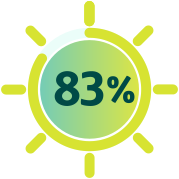
83% of VYALEV patients reported waking up in the good “On” state at week 12
Post hoc analysis
Percentage of Patients (n=46)
Hours After Waking
- %
- %
- %
- %
Observed reduction in sleep disturbances at week 125
In patients with advanced Parkinson's disease

LS mean change from baseline to week 12 in PDSS-2 total score
VYALEV is indicated for the treatment of motor fluctuations in adults with advanced Parkinson’s disease.1
Limitations: PDSS-2 was a ranked secondary endpoint in the registrational 12-week study. Due to nonsignificant results for endpoints higher in the testing hierarchy, these results are observational in nature and any comparisons between treatment arms should be interpreted with caution.
The Parkinson’s Disease Sleep Scale-2 (PDSS-2) is a patient-completed clinical rating scale that assesses the frequency of sleep disturbances in patients with PD. Total scores range from 0 to 60, with lower scores indicating fewer sleep disturbances. The scale consists of 15 questions that are grouped into 3 subdomains:

Motor symptoms
at night

PD symptoms
at night

Disturbed sleep
VYALEV is indicated for the treatment of motor fluctuations in adults with advanced Parkinson’s disease.1
Data Limitations: PDSS-2 was a ranked secondary endpoint in the registrational 12-week study. Due to nonsignificant results for endpoints higher in the testing hierarchy, these results are observational in nature and any comparisons between treatment arms should be interpreted with caution.
In the pivotal study, oral IR CD/LD was converted to VYALEV, so
VYALEV replaced all scheduled oral IR CD/LD1,2,6
On average, patients in the VYALEV group were taking 12 IR CD/LD pills per day at baseline** and 0 IR CD/LD pills per day at 12-week study end††
Average number of IR CD/LD pills per month (30 days)

Note: Additional doses of rescue IR CD/LD may be needed if the VYALEV Pump is not working or is disconnected for a prolonged period. Refer to the VYALEV Pump Instructions for Use for more information.§§
Limitations: Patients in the pivotal study were required to convert all levodopa-containing medications and COMT inhibitors to IR CD/LD prior to randomization, and were required to use oral levodopa for rescue doses. This led to a reduction, on average, of 12 levodopa pills per day at baseline to 0.9 rescue levodopa pill per day at week 12; based on oral levodopa dose of Sinemet® 25/100 (25 mg carbidopa/100 mg levodopa).
**Mean daily dose of oral levodopa at baseline was 1202.7 mg.
††Mean daily dose of levodopa from all sources at week 12 was 1793.3 mg (levodopa delivered through the pump as VYALEV: 1703.7 mg; levodopa taken orally: 89.6 mg).
‡‡For illustrative purposes. Exact dosage as well as dose frequency and timing varied among patients in the pivotal study.
§§The maximum recommended daily dosage of VYALEV is 3525 mg of the foslevodopa component (equivalent to approximately 2500 mg levodopa). In the clinical trial, all dosages of levodopa-containing medications and COMT inhibitors were converted to VYALEV. Prescribing a backup oral carbidopa and levodopa product is recommended in the event that delivery of VYALEV is interrupted, which may result in underdosing.1,2
Study Design: A phase 3, randomized, double-blind, active-controlled study to evaluate the efficacy and safety of VYALEV vs oral IR CD/LD over 12 weeks in 141 patients with advanced PD. In this study, concomitant PD medications were allowed; however, no changes were permitted. Patients could take oral IR CD/LD as needed for rescue. Mean daily dose of levodopa at the end of the study: 1793 mg with VYALEV; 1213 mg with oral IR CD/LD. Due to pivotal study design, the high rate and extra dose were disabled to maintain blinding.
Review the safety profile of VYALEV.
BL=baseline; CD=carbidopa; COMT=catechol-O-methyltransferase; IR=immediate release; LD=levodopa; LS=least squares; PD=Parkinson’s disease.